I know it's been a couple of months since my last Moving to France post, but this one was a bit of a challenge to put together.
(
Update: Check out this
article)
Once you arrive in France and get your
Carte de Séjour sorted out, you will want to join the fabulous French health system. Actually you
must join the French health system. All permanent residents in France are
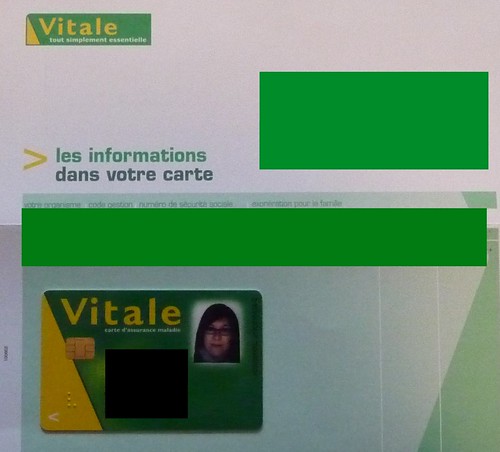
obliged by law to have national health insurance, which comes in the form of a little green card, the
Carte Vitale.
The information on this topic is rather extensive, so in the end, instead of painstakingly re-wording the material from the French government websites, I have simply copied the relevant sections of the
Sécurité Sociale guide.
So, without further ado...
how to join the French health system.
As it states in the
Livret de Santé:
"In France, everyone is entitled to health insurance to cover the cost of medical care. It is preferable to apply for it before becoming ill. The first step is to apply for “basic” public health insurance, which can be extended by paying for private supplementary insurance ("mutuelle"). For people with a low income, supplementary insurance is available free of charge and is known as supplementary universal medical cover (CMU-Complémentaire).
Who is entitled to “basic” public health insurance?
“Basic” public health insurance (including “basic” CMU) is an entitlement for anyone legally residing in France for at least three months before the request for healthcare (except asylum-seekers who are exempt from this condition).
Where should I apply for public health insurance?
Go to the public health insurance centre in your neighbourhood (ask for the address from the Town Hall’s CCAS, or social assistance centre). If you are using a government-assigned address, go to the public health insurance centre whose address is listed on your certificate of domiciliation.
Documents required:
- Identity: the preferred document is birth certificate, otherwise a passport, identity card or certificate of registration with the OFPRA (French Office for the Protection of Refugees and Stateless Persons) for asylum-seekers or any other document giving proof of your identity;
- Address: certificate of accommodation (with receipt for rent or EDF bill) or government-assigned address registered with an approved organisation. Important: make sure that letters actually reach this address;
- Legal residency in France: any valid residency document issued by the Prefecture: residency card, temporary stay card, proof of receipt of application, temporary approval for stay, appointment/summons, asylum notice, etc.;
- Income: written proof of all income received from January to December of the previous year (wages, welfare benefits, etc.).
Using the Public Health cover System
As a general rule, the public health insurance system reimburses two-thirds* of your healthcare expenses (except on glasses and dentures), but the patient must pay the entire sum first. In healthcare centres, hospitals and certain doctors’ offices and pharmacies, patients may pay only one-third of the expenses (known as the “ticket modérateur”), by showing their health insurance card (paper certificate or Vitale Card). Supplementary CMU insurance or mutual and private insurance companies cover the additional amount.
Important: the “100%” is not free in all cases: those with certain chronic illnesses can be exempt from paying the ticket modérateur, and are considered “100% covered by the public health insurance system”. However, the “100%” applies only to the care received for chronic illnesses."
The French Government
Website (in French)
I have to add that the following documents may or may not be asked for (
some have already been listed above) but you should have them ready just in case.
- Passports
- Details of place of birth (as well as your partner's and children's information)
- Marriage and birth certificates of all family members
- Proof of address in France with proof of ownership (deeds) or rental agreement
- Date of permanent arrival in the departément
- Proof of residency in France for at least three months (in the form of three months EDF or France Télecom bills, rent statements or mortgage payments or a notarized statement of your home purchase)
- Proof of income for at least the previous 12 months, whether in France or elsewhere or an avis d'imposition or latest French tax bill.
- A RIB (Relevé d'Identité Bancaire) provided by your bank
~~~~~~~~~~~~~~~~~~~~~
Our
Carte Vitale story just goes to show that doing your homework when dealing with French bureaucracy will (
sometimes) get you everywhere!
We went to the local CPAM office in Béziers to apply as soon as we got our Cartes de Séjour, as we had been informed to do. Luckily we had armed ourselves with knowledge of the current law, because even though it had passed a few years before, the powers that be obviously forgot to send the memo down south to the CPAM office in Béziers.
The man behind the desk told us quite confidently that
non, we couldn't join the French health system because France had no reciprocity with America, which is true - France and America do not have reciprocity when it comes to medical care. In turn, we confidently and patiently told him that it didn't matter, because (
at the time) the law stated that
anyone legally residing in France for at least three months of the year must join the system.
He sat there for a moment, staring at us with a kind of deer-in-the-headlights look, then suddenly grabbed the telephone and made a couple of calls. When he hung up he looked at us with a smile and said
oui, you are correct."
Phew!
Thirty minutes and a mountain of paperwork later, we were official Carte Vitale carrying residents of France.
*To cover the 30% of costs that are generally not covered by the system, we purchase a Top Up, or
mutuelle from a
private company. The price for the two of us is about €130 a month and although many people we know choose not to have the added expense, we like that it gives us the freedom to go to private doctors as well as state doctors.
The next installment of the series will be about obtaining the elusive
10 Year Carte de Résident. Some of the stories I've heard on this subject have been real doozies and would love to hear from more of you if you want to share your experiences.
.
Pin It